Sunday, September 19, 2010

Emerson essay

Here's my Emerson essay. Prompt:  use Frederic Edwin Church's painting Heart of the Andes as a jumping board for Emerson's thoughts on nature in his essay "Nature" or other essays. I received a B+ on the paper, since my paper was under the page limit.

My abstract: Both Emerson and Church show that nature is but an illusion to an average man.  An educated man, one that is skilled in lessening Reason to see Beauty, will see images of nature whether in nature or on canvas, and in his own mind will translate these sights into the divinity that nature encapsulates.    


My essay:

Finding Grace

Emerson’s man may not find truth in nature, but with open eyes he may see the landscape of God’s grace.  Emerson’s essay “Nature” is littered with references to inaccessible points of beauty—inaccessible not for lack of availability, but impermeable due to an educated man’s overly complex Reason.  A single innocent child, one without developed reason in his head, has a better chance at seeing the grace in nature than a mob of men. However, Emerson argues that a truly educated man with an open mind to may find nature’s “kindred impression”.   A truly educated man will translate the images of beauty and find not their secrets, but their divine grace.

Emerson is dismissive of most men, for, “To speak truly, few adult persons can see nature (5).”  On the contrary, Federic Edwin Church ushered in thousands of these adult persons to see his version of nature.   The Heart of the Andes was the most widely seen painting in Church’s era, and it’s no accident that his painting depicts a far away land while it was stationed squarely in America.  Church offers up a hyperreal depiction of nature, one that audiences could view in a dark room and be transported in their minds to a land where fairy tales might reside.  His vision of nature is a nature that few of the viewers would ever attempt to travel in person to see, though of course, his depiction of nature is not of a real singular place.  This exhibit of nature was a commodity; a chance to travel without leaving one’s neighborhood.  Emerson might have believe that these thousands of customers were not truly experiencing nature for what nature can be for, “Nature never [becomes] a toy to a wise spirit (5)”.   An Emersonian educated viewer of The Heart of The Andes would not see it as a representation of land and trees and lakes, but would experience the painting with a sort of reverence of nature’s divine spirit.

Eat Pray Love movie review

When you’re watching a movie and find yourself realizing that you enjoy the ravioli’s personality better than the lead actor’s, you know you have a problem. 

Julia Roberts does all she can to glow and smile, and crunch up her forehead in desperation when called for, but she can’t save this movie from it self-indulgence.

The story of Elizabeth (Liz) Gilbert has been talked about in book clubs since 2004’s Eat Pray Love first hit the best-seller’s list.  In the book, Liz comes across as a humbled friend with a self-deprecating wit and real passion for travel.  In the movie, Liz is a fun but utterly spoiled brat enjoying a nice vacation.

The movie opens with a gorgeous shot of Roberts pedaling through the lush scenery of Bali.  Cut to New York a few years earlier and a more drab, but no less fabulous Roberts enjoying the middle-rich life of a published travel writer on her second novel, a beautiful husband, funny and successful friends, not to mention a trendy apartment.

So…what is her plight exactly?  She has everything but feels trapped.  This theme has been on the big screen lately with “chronically dissatisfied” Cristina from Vicky Cristina Barcelona (Scarlet Johansson), and desperately unhappy with the American dream April Wheeler from Revolutionary Road (Kate Winslet).  So why did Johansson and Winselt do so much better in the same topic?

Much of the movie’s faults begin in the first opening minutes.  We never truly understand what’s eating Gilbert, Liz.  She suggests that since she “was fifteen I was either in a relationship with a man or breaking up with one.  I haven’t had two weeks to deal with myself.”  So why does she fall into a steamy relationship with young actor (James Franco) about 15 minutes into the movie?  It’s a mid-life crisis calling itself a journey. 

Look, I don’t want to rain on a pretty girl’s parade, but if I’m watching a movie about a person running away from something so profound she needs to leave the country for a year I’d like to at least understand why she’s running.

However, I am glad that she ran to Italy first.  The rich Italian food and the splendor of the ancient city are shot with such passion it’s nearly pornographic.  In Italy, Liz finds friends, and wine, and quiet solitude of all things beautiful.  Roberts is never as warmly magnetic as she is while setting a crisp asparagus on her plate in this city of fairy tales.  We wish we could join her.  Then again, if we were there she’d probably ignore us.  Much happens in the lives of her friends in Italy but Liz is never shown being a part of it.  She is the center of her own universe.

Wednesday, September 8, 2010

On friends cheating

Unfortunately, I’ve been waiting for that inevitable time when someone in my life cheating on their partner.  I wasn’t sure exactly how I would react, and now that’s it’s here I have some thoughts.

The thing is, I’m highly aware that we are biological creatures aiming to be rational ones.  Our impulses are highly animalistic—we want cry aloud in public if we stub our toe, want to physical harm people when we’re angry, we want to have sex with an attractive people who gives us attention, we want to run away when we are embarrassed, ect.  We want these things, but we are rational people, and we try our hardest to say no.  We say no to showing weakness in public, no to violence, no to cheating, and no to fleeing.  At least we try not to be overly biological.  Because being rational, and kind, and respectful is what our humanity is made of, and how we maintain relationships in this society structure.

Could I lie?  Steal? Cheat? Hurt? And not give a fuck?  Oh yes, I do have that capacity, and so do you.  But if I did these things, I could not belong in this social ethical environment, for I have too much value on love, too much value in trust, and an overcompensated value on personal respect.  Ethics is a code of behavior, which has both rewards and consequences.  Morality is personal ethics code of how we interpret right from wrong. 

Let me tie this together with friends cheating: I am a moral person so if I were to cheat I would have the remorse of hurting the person I’m dating plus those who respect me as an honorable person (including my own self-respect), furthermore, I am an ethical person and if I were to cheat I would lose the societal rewards of love, respect, and compassion because society cannot risk everyone cheating, for it would lead to a lack of trust within the trade-based society.  How could business, love, and commerce function if every time a trade based on faith of trust was broken?  There would be no trust for further trade to happen.  No structure, no society, no protection and kindness.  Of course, if society was based on a hook-up based structure things would be less stringent and cheating would not be a problem since there were no ties to break to begin with.  Society would be perhaps more spontaneous, but less stable, and in my opinion, less loving.  I couldn’t live in a world without both romantic and friendly love.  In conclusion of this paragraph, society cannot afford cheaters and on a personal basis I could never be a cheater.

Friday, July 23, 2010

Christian Louboutin: our post-grad plan

On a stylish and blistering hot summer night ten fabulous college friends roamed the ritzy streets of Scottsdale, Arizona in beautiful non-designer heels.  

Drunkenly swaying down the sidewalk from one jumping club to the next, plans of post-college came up in conversation once more.  Though unlike most conversations of late it did not revolve around law school, grad school, or Hollywood, but instead a more more appealing form of a diploma: Christian Louboutin shoes.

His shoes are recognizable by mere glances, with his signature shoe being a sleek black stiletto with the bold and naughty red underbelly. In the latest issue of Vogue, Oscar winner Marion Cotillard has a five-page spread featuring classy fashion, stunning locations, all while wearing the same pair of gorgeous black ruffled Christian Louboutin pumps.  One pair is all a girl really needs.  Or can afford for that matter.  They run between $700-900 a pair.  Hell, even knock-offs are $200.

photo credit goes to Vogue Magazine  

As we walked along the streets of Scottsdale my roommate Sarah and I sighed in want of such a pair.  My Friend In The Purple Dress is equally smitten with shoes, though "No one would ever guess that," she said.  Looking at my own closet I know exactly what she means by that.

We're the generation of girls post-Sex and the City, and entrenched in current hipster fashion.  We've grown up these past few years loving the high fashion of Carrie, Samantha, Miranda, and Charlotte, but we can only afford Target and Urban Outfitters.  Furthermore what's hot these days are multiple layers of clothes, vests, hats, muted tones, lots of stripes, and flip-flops with skinny pants.  I love the look, personally, but I do know that someday my flip-flops are going to graduate into heels.

This is where Christian Louboutin fits in.  As Sarah put it, she'll know she has arrived in life when she can wear her very own pair--and not give up eating for 3 months to pay for them.  Will we ever get that point?  Maybe.  But even if we don't, for now, in our final year of college, as we flip through texts books, check books, and Cosmo, it sure is fun to dream.

*all photos in this blog entry are credit of Christian Louboutin and Vouge Magazine

Wednesday, July 21, 2010

Book Review: Into Thin Air

Standing on the summit of Mount Everest, oxygen-starved Jon Krakauer opens Into Thin Air with a tone of small pride and greater desperation.  Krakauer writes in a tone of fear for his own survival at the top of the world, and trails off that he had no idea that that day in May 1996 would be tragic for so many lives involved.  It’s a powerful scene that cuts right into the action and suspense of the controversial event that happened so many years ago on top of the most dangerous mountains on Earth. 

The May 1996 Disaster and the year itself is one of the deadliest on record for the mountain.  Krakauer happened to be on one of the teams that were affected that May, giving him an usual vantage point of journalism, as well as guilt from his possible involvement with adding to some of the deaths of those eight climbers.

The book’s chapters start with dark black and white art pieces of Everest as well as a date and height of the action.  Following this opening chapter is a briefer chapter about the history of Mount Everest and how it got its name and measurements.  This is one of Krakauer’s best writing tricks: nothing is a simple event but a full context of how this person or that person ended up in the cross-hairs of circumstances.    

Things started going downhill for Into Thin Air soon after that, however.  There was a certain tone of Krakauer’s that I couldn’t quite place.  This tone cuts in and out as sometimes he is distinctly emotionally removed as his lists the prices of a quest up Everest and the reputation of the climbers.  However, by mid-book this tone is back and fully realized when he quotes a peer climber who was interviewed after the disastrous trip to say, yes, having a journalist along for the trip might have influenced people to act in ways they wouldn’t if they weren’t being recorded.  Perhaps he, a member of the press and possible publicity he represented, was the reason the guides did not turn their clients back at 2pm whether they reached the summit or not, exposing several clients to freezing temperatures for far longer than recommended, and trapping them onto of Everest during a powerful and deadly storm.

It was then that I realized that this unsettling tone is one of an apology.  Krakauer writes as if the audience has already heard about the story and this is his confession for the events on the mountain. However, this tone is often broken up by journalistic professionalism shedding light on the commercialization of the mountain and the background of each of his climbing peers.  

It is this mixed message tone that is Krakauer’s greatest flaw in Into Thin Air.  As the story progresses from Base 1 to Base 2 he tries to describe the characters as a non-involved journalist, but then will descend into lightly judging the inexperienced climbers for being on the mountain in the first place, only to take back his comments into euphemisms as a sort of reverence to the deceased.  He can’t make up his mind if this is a non-fiction journalistic account of the disaster, if it’s an apology for his part in it, or if it’s an essay exploring why people climb Everest in the first place despite dangers.  The entire book is gripping but it’s also scattered.

While Krakauer does open each chapter with a passages about Everest from varies sources through the ages, beyond the second chapter he only sprinkles historical facts throughout the rest of the book.  It feels inconsistent as to the context of climbing the mountain, especially after reading his other works and knowing how thorough he is when explaining tragic circumstances of a place and time.

He also takes great pains in trying to give honor to the deceased by peppering the novel with dozens of names.  In fact, there is a 7-page list of climbers at the beginning of the book.  Unfortunately there are simply too many characters to remember and by consequence, the emotion connection to each of them is weakened. 

It is his summary of the fellow climbers however that has received the most amount of press for Into Thin Air.  He describes at length the actions of guide Anatoli Boukreev who left behind much of the climbing party on top of the mountain that fateful day.  Krakauer is highly scornful of this, and wonders at length how events would have been different if an extra guide would have stayed near the summit.  While Krakauer later explains that Boukreev risked his own life by leaving the safety of base camp to search for survivers (and rescued a few of them).  Boukreev later wrote his own account of the disaster, slamming Krakauer’s villainous depiction.

What’s interesting is that Krakauer is not as harsh on his own guide, Robert Hall and his decision to not turn back his clients at the 2pm deadline, but to carry on despite the risks.  It’s also disturbing to read Krakauer’s picky choosing of whose deaths he feels personally responsible in causing.  At times it appears that Krakauer the journalist blames himself for most of the deaths, then at times he appears the most responsible for Andrew Harris, whose death still plays for a bit of an mystery for Krakauer and others, but none is more tragic then the Krakauer mild view of the death of Yasuko Namaba.  Krakauer explains that some inevitable death is more obvious then others, but through a series of events it is more and more obvious that the 90-pound woman could have been carried back to Base and saved.  Krakauer has remorse but not nearly enough considering he was so close to her body at the time.

Into Thin Air is a suspenseful and is haunting for both the reader and the author.  In a near twenty-page epilogue Krakauer continues to plays devil’s advocate for the responsibility of tragic events.  Is it journalism’s fault?  Is it commercialization?  Is it zealous guides hoping for a better reputation?  Krakauer can’t seem to decide. 

Perhaps it is unrealistic for one to make firm assertions after witnessing horror first-hand.  But to be indecisive between removed emotions versus heartfelt remorse is too irresponsible on Krakauer’s part of both a journalist, a survivor, and a novelist. It’s been over a decade since the first edition: it’s time for  Krakauer to stop hiding behind his own mountain of ambivalence .     

Wednesday, July 14, 2010

22 songs for Summer

22 songs of summer 2010

Whether it’s road-tripping or skinny-dipping, summer deserves a soundtrack for the fun and the scandals.  Here are my current 22 favorite songs playing on repeat on my iPod.
  1. Break Your Heart -- Taio Cruz feat. Ludacris
  2. Rock That Body  -- Black Eyed Peas
  3. California Gurls – Katy Perry feat. Snoop Dogg
  4. Shots – LMAO feat. Lil Wayne
  5. Get Buck In Here –DJ Felli feat. Akon
  6. The Wolf – Black Carl
  7. California Love – Tupac
  8. When You Were Young – The Killers
  9. Terrible Things – April Smith and the Great Picture Show
  10. Winner – Justin Timberlake feat. Jamie Foxx
  11. Fantasy Girl – Baby Bash
  12. Not Myself Tonight – Christina Aguilera
  13. P.I.M..P. – 50 Cent feat. Snoop Dogg
  14. Eenie Meenie – Sean Kingston
  15. Breakeven – The Script
  16. Kids (Pet Shop Boys Synthpop Mix) – MGMT
  17. Billionaire – Travie McCoy
  18. McFearless – Kings of Leon
  19. Gold Digger – Kayne West feat. Jamie Foxx
  20. Jamming – Bob Marley
  21. What Part Of Forever – Cee Lo Green
  22. Chop and Change – The Black Keys

Monday, July 12, 2010

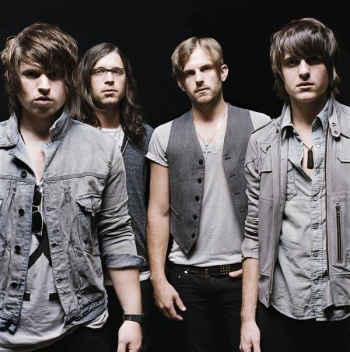
Review: Kings of Leon concert

Like most people I hadn't heard of Kings of Leon until late 2008 with their hit single "Sex on Fire".  At first I thought it was something of the late 80s era of Journey or Bon Jovi, and was confused on why it was playing on virtually every station that winter.  When a friend informed me that Kings of Leon was a "new" band and that "Sex on Fire" was about "/The head while I'm driving/" I was more than a little intrigued at who this band was.

Kings of Leon formed in Nashville, Tennessee back in 1999 with brothers Caleb Followill, Nathan Followill, Jared Followill, and cousin Matthew Followill, with the influence of southern rock being found in the gruff of lead singer Caleb's voice as well as the simple guitar riffs. At their best, the band sounds like the epic stadium ballads of U2 and at their worst, sound like listless and dull Coldplay, only with a harder edge and less joy. Needless to say, they're on repeat on my iPod for driving solo or homework or dinner parties, but I was rather hesitant on how well they could play an energized show in Chula Vista, California on Friday night.

As I walked up to my lawn seats I was worried that The Cricket Wireless Amphitheater, with its cheap plastic appeal and a short walk to a water slide park, would affect a rock performance.  I didn't foresee the smashing of guitars, that was for sure.  Looking around I'd say a good 90% of the crowd were well dressed Caucasian thirtysomethings who appeared to be more excited about drinking beers with pals than watching the band play.  Regardless, I was bubbling with excitement as the lights dimmed and Kings of Leon walked on stage to much applause.  

They opened with "Crawl", a midtempo song which showcases Caleb Followill's grit of voice and lyrics about the crucified USA and the abused population.  Kings of Leon often have high-charged lyrics about good things lost, late nights, and hope, though frequently their melodies overpower their lyrics, resulting in more of a mood, a sort of aura of a smoky bar in the dead of night, rather than a message. 

The band slipped in a few songs in a row without pause, including fan favorite "My Party" about the coming of age and a girl who finally notices him.  As the happy crowd, at nearly full capacity in the 20,000 seating for the Amphitheater, sang along with their beers in tow it was obvious that this band has a loyal following, though definitely not to any loud decibel as one might expect at a rock show.  
The band was on point with "Sex on Fire", which got a healthy round of applause despite the lifeless, near obligatory attitude of the band when it started, and "Manhattan" was equally as enjoyable with its intricate bass sound and upbeat lyrics like "We're gonna fuel the fire/ gonna to stoke it up/ We're gonna sip this wine/ and pass the cup/ who needs avenues/ who needs reservoirs/going to show this town/ how to kiss these stars".

While Kings of Leon played their songs flawlessly, there was no momentum by the band, no walking around the stage, no storytelling of the songs or the tour, no enthusiasm before, during, or after each song--as if each song was mandatory and unloved.  I couldn't help but wonder if a teenager on vicodin could have done a more stimulating performance on Rock Band.  

It was apparent that the most popular songs were the ones from their latest album Only By The Night, with favorites like "Be Somebody" and "On Call" sparking some singing along and dancing in the crowd. Kings of Leon addressed the audience a handful of times thanking everyone for coming out, but it seemed begrudgingly.  Some of the best concerts I've been to have had zero to none special effects, but Kings of Leon's special effects of the black-on-white video feed on the Jumbo Trone and the occasional lights panning over the crowd seemed more like cheap tricks than fun playful gimmicks.

At least the music was good.  Despite the morose stance of the band, songs like "Notion" with its good vibes and rock-heavy sound of loud guitar, weepy keys, and that hard gravel voice inspired some swaying and emotion from the crowd--myself included.

Kings of Leon came back for their encore playing their massive hit "Use Somebody", which sounded just as beautifully epic in person as it does in an iPod, though you couldn't get that impression by looking at the passionless band playing the song. In the end, perhaps that's the issue with Kings of Leon: their music is epic but the band is meek.   I want a band that puts every damn emotion into a rock song.  I want a band that talks to the crowd and taunts the rules of the amphitheater.  I want a band that understands that a rock show, even a mild quiet rock show, deserves some grit and boast.  I should have gone to Coldplay instead